


 Free US Calls: 1-888-433-4735
 International: 305-545-5588
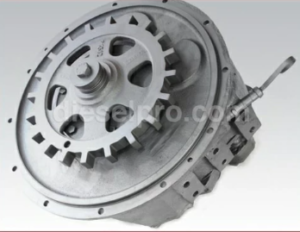
Introduction
- Overview of the Twin Disc MG-506 Marine Transmission
- Key Features and Benefits
- Safety Precautions and Warnings
Specifications for Twin Disc 506 Marine Gear
- General Specifications (Weight, Dimensions)
- Technical Specifications (Torque, Power Rating, Gear Ratios)
- Fluid Capacity and Type
- Operating Parameters and Limits
Installation Guide for Twin Disc 506 Marine Gear
- Pre-Installation Checklist
- Tools and Equipment Required
- Mounting Procedures
- Alignment Guidelines
- Fluid Connection Procedures
- Final Inspection Before Initial Operation
Operation Instructions for Twin Disc 506 Marine Gear
- Starting Procedures
- Shifting Instructions (Forward, Neutral, Reverse)
- Normal Operating Practices
- Monitoring and Adjustments During Operation
- Shutdown Procedures
Maintenance Guide for Twin Disc 506 Marine Gear
- Regular Maintenance Schedule
- Lubrication and Fluid Change Intervals
- Inspection of Key Components (Filters, Seals, Clutches)
- Troubleshooting Common Issues (Noise, Vibration, Slippage)
- How to Address Minor Leaks or Adjustments
- Long-Term Storage Guidelines
Troubleshooting and Diagnostics for Twin Disc 506 Marine Gear
- Identifying Common Problems
- Step-by-Step Diagnostic Procedures
- Corrective Actions for Common Failures
- When to Seek Professional Assistance
Rebuilding and Overhaul Basics for Twin Disc 506 Marine Gear
- Symptoms Indicating Rebuild Requirements
- Required Tools and Setup
- Component Disassembly Overview
- Parts Inspection and Replacement Guidelines
- Reassembly Procedures
- Post-Rebuild Testing and Adjustments
Replacement Parts Guide for Twin Disc 506 Marine Gear
- List of Commonly Replaced Components
- Recommendations for Using Premium Aftermarket Parts
- Guidelines for Ordering Replacement Parts
- Compatibility Considerations
Frequently Asked Questions (FAQ)
- What fluids are recommended for the MG-506?
- How often should maintenance be performed?
- How can I identify signs of wear?
- Can I use aftermarket parts for repairs?
- What are common operational mistakes to avoid?
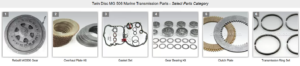
Rebuilt Twin Disc MG506 Marine Transmissions
Bearings For Twin Disc MG506 Marine Transmissions
Plate Kit For Twin Disc MG506 Marine Transmission
Gasket Kits For Twin Disc MG506 Marine Transmission
Rebuilt Twin Disc MG506 Marine Transmissions — Ratio Selector
Below you’ll find the four most-requested MG506 reduction ratios. All MG506 transmissions in this section are spin tested to verify reliable operation before they leave our facility. They are typically supplied as exchange units with a refundable core deposit; details appear on each product page. Availability indicators (e.g., “In Stock”) and images are included where applicable to streamline your decision-making and order process.
MG506 Rebuilt — 1.5:1 Reduction
The MG506 in a 1.5:1 ratio is a versatile choice for operators targeting a balance of engine RPM, propeller load, and vessel speed. This ratio often suits lighter boats or applications where quick throttle response and midrange efficiency are favored.
Where this ratio shines
-
Planing or semi-planing hulls seeking brisk acceleration and responsive handling.
-
Applications where propeller diameter is limited, and slightly higher shaft RPM is acceptable.
Selection notes
-
Confirm your bell housing pattern (many MG506 units have been produced with different SAE housing options over the years).
-
Verify the input coupling specs and flywheel pattern to match your engine.
-
Match the output coupling to your shaft flange (bolt circle, pilot, and overall diameter).
-
Check rotation requirements for your driveline (LH/RH). The MG506 family includes variants for different rotation configurations; confirm what your installation requires.
Good practice
-
Compare your current dataplate (model, ratio, serial) with the ratio you’re ordering.
-
Validate case style (some MG gears are referred to as “shallow” or “deep” case by installers). If you’re replacing like-for-like, note what you have now and keep components consistent when possible.
What you can expect
-
A spin-tested MG506 1.5:1 that has been functionally verified.
-
Clear details on the core exchange so you know exactly how to secure your refundable deposit.
MG506 Rebuilt — 2.0:1 Reduction
The 2.0:1 MG506 is popular across a wide range of working and pleasure craft for its balanced torque multiplication and propeller loading, especially when upsizing prop diameter for better bite and low-speed control.
Where this ratio shines
-
General-purpose marine service seeking smoother low-speed maneuvering without sacrificing cruise efficiency.
-
Operators wanting more propeller authority for docking, towing, or frequent load changes.
Selection notes
-
Confirm shaft coupling pattern and output flange dimensions (ensure the output coupling you select matches the 2.0:1 variant of the MG506 you’re ordering).
-
Review your existing mount geometry (height and footprint) to keep alignment swift during change-out.
-
Cross-check cooling and oil line routing on your vessel to avoid surprises at install.
What you can expect
-
Fully spin-tested MG506 2.0:1.
-
Exchange terms with refundable core deposit clearly disclosed on the product page.
MG506 Rebuilt — 2.5:1 Reduction
Stepping to 2.5:1 gives you more torque multiplication at the shaft, which is helpful for heavier vessels, workboats, or applications prioritizing push, grip, and controlled low-speed handling over top-end speed.
Where this ratio shines
-
Heavier displacement vessels and utility craft that need strong low-end thrust.
-
Situations where a larger-diameter propeller is desired for better grip and station-keeping.
Selection notes
-
Confirm propeller sizing targets (diameter/pitch) with your naval architect or prop shop and ensure your ratio selection supports those goals.
-
Match your output coupling to the 2.5:1 unit you’re purchasing; coupling specs vary by model iteration.
-
Keep an eye on gear oil cooler capacity and plumbing layout; verify compatibility with your existing cooling circuit.
What you can expect
-
A spin-tested MG506 2.5:1 built to deliver reliable torque transfer.
-
Standard core exchange process with a refundable deposit, presented up front.
MG506 Rebuilt — 3.0:1 Reduction
The 3.0:1 variant emphasizes low-speed authority and high-thrust scenarios. It’s a go-to for operators who value push over speed—tug operations, certain fishing applications, and vessels frequently working against wind, current, or load.
Where this ratio shines
-
Displacement and heavy-duty service where controlled, deliberate thrust is mission-critical.
-
Operators counting on precise maneuverability and strong bite at low speeds.
Selection notes
-
Double-check rotation and case style. As MG506 models span production years, variants exist; aligning these details shortens downtime.
-
Match your output flange and shaft hardware to avoid delays; consider replacing aged couplings and mounts at the same time for best results.
-
If you’re moving from a different ratio to 3.0:1, revisit propeller specifics to avoid overloading the engine.
What you can expect
-
A spin-tested MG506 3.0:1 ready for service.
-
Clear core return and refund steps to protect your deposit.
MG506-Compatible Accessories & Hardware
Matching accessories to your MG506 reduces vibration, protects the drivetrain, and speeds up change-outs. Below are items commonly paired with MG506 transmissions in the field. Confirm measurements and patterns from your existing components (or provide your dataplate and photos) so we can verify compatibility before you order.
Ring Drive — MG506 (also used on MG507 & MG507-1) — Housing Size SAE #2
This ring drive matches MG506 installations that use an SAE #2 housing. It’s also shared across related models such as MG507 and MG507-1 in many configurations, which is why it’s a frequent choice for MG506 users standardizing spares across fleets.
Key considerations
-
SAE #2 housing spec: verify your bell housing size on the dataplate or by measurement.
-
Check tooth form, pitch diameter, and mounting points if you are replacing only the ring and not the full coupling assembly.
-
If your existing setup is SAE #1, do not assume interchangeability—ask us to confirm the correct ring drive for your exact MG506 variant.
Why this matters
-
Using the correct ring drive maintains concentricity and balance at the engine-to-gear interface, reducing wear and vibration while preserving seal life.
Rubber Block — Vibration Isolation for MG506 (also used across MG507/MG509 in many setups)
The rubber block supports torsional damping and reduces transmitted vibration. Even small amounts of degradation in the rubber can show up as chatter, clunking, or premature wear elsewhere in the driveline.
Key considerations
-
Replace in sets when practical. Mixing old and new isolators can create uneven support and misalignment under load.
-
Verify the block’s dimensions and hardness rating against your existing mount design.
-
If your vessel operates at extended idle or under frequent gear-shifting (e.g., harbor work), proactive replacement pays dividends in noise reduction and component life.
Why this matters
-
Healthy isolation protects the transmission, reduces operator fatigue, and keeps interior noise in check—particularly noticeable in enclosed pilot houses and cabins.
Output Shaft Coupling — MG506 (for 1.50:1, 1.97:1, 2.50:1 ratios)
This MG506 output coupling is designed for gears with the following ratios: 1.50:1, 1.97:1, and 2.50:1. Matching the coupling to your specific ratio and flange geometry is essential for proper shaft alignment and load transfer.
Key considerations
-
Confirm bolt circle, pilot bore, register, and overall diameter.
-
If your current flange shows fretting or ovalized holes, replacing the coupling during the transmission swap can prevent recurring alignment issues.
-
Consider new fasteners and locking hardware to maintain clamp load over time.
Why this matters
-
A correct, tight, and true coupling preserves bearing life and minimizes vibration. It also makes future service work (like alignment checks) faster and more predictable.
MG506 Identification & Selection Checklist
Choosing the right MG506 is straightforward when you gather a few details up front. Use this checklist to confirm fitment:
Dataplate Essentials
-
Model: “MG506” should be clearly shown on the plate.
-
Ratio: 1.5:1, 2.0:1, 2.5:1, or 3.0:1 (or 1.97:1 on certain variants tied to specific couplings).
-
Serial / Spec: Helps us pinpoint build differences across production years.
Bell Housing & Flywheel Interface
-
SAE size: Many MG506 installations use SAE #2; some installations may differ. Confirm what you have.
-
Flywheel pattern: Match engine flywheel drilling and pilot dimensions.
-
Ring drive: Verify the correct ring drive for your housing size and engine flywheel.
Rotation & Case Considerations
-
Rotation: Confirm LH/RH requirements for your driveline.
-
Case style: Some installers refer to “shallow” vs. “deep” case variants; note what you’re replacing.
Output Side
-
Coupling: Identify bolt circle, pilot, and OD; confirm compatibility with your shaft flange.
-
Shaft alignment: Plan to check alignment after install to protect bearings and seals.
Mounting & Isolation
-
Rubber blocks/isolators: Inspect condition; consider replacing in sets.
-
Mount height/footprint: Verify dimensions to reduce alignment time.








Hi, can you tell me if I can replace my old Twin Disc 506 with a 506-1?
and or what the difference is?
Regards
Paul