


 Free US Calls: 1-888-433-4735
 International: 305-545-5588
The Legacy of the Detroit 4-71 (2 Valve Head) and Where It Can Be Found Today
Introduction
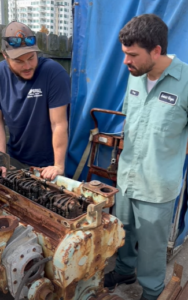
The Detroit Diesel 4-71 engine stands as one of the most recognized powerplants in the history of diesel propulsion. A four-cylinder member of the venerable Detroit Diesel 71 Series, the 4-71’s unique two-stroke operation, mechanical simplicity, and exceptional longevity gave it a distinct place in mid-20th century engineering. Among its variants, the 2-valve head version became particularly emblematic for its role in countless industrial, marine, and military applications across the globe.
The 4-71’s influence stretches across nearly a century of service and innovation. This article provides a deep dive into the origin, design, legacy, and present-day relevance of the 2-valve head Detroit 4-71 engine.
Historical Background of the 71 Series
General Motors and the Birth of the 71 Series
In 1938, General Motors (GM) created the Detroit Diesel Division with the intent of developing compact and reliable diesel engines. The 71 Series was introduced as GM’s answer to the growing demand for light- and medium-duty diesel power. Designed with a unit-injected, two-stroke architecture, these engines were quickly adopted for everything from trucks to tugs.
Modular Design Philosophy
The 71 Series’ naming convention was simple—each cylinder displaced 71 cubic inches. The modular design allowed variants like the 1-71, 2-71, 3-71, and so on, up to the massive 24-71. Each engine used shared internal parts, making serviceability and parts availability a hallmark of the series. The 4-71 was one of the most balanced configurations, combining compactness with enough power for a wide range of uses.
Detroit 4-71 (2-Valve Head) Overview
Engine Configuration
-
Cylinders: 4
-
Cycle: Two-stroke
-
Valves per Cylinder: 2 (one intake, one exhaust)
-
Displacement: 284 cubic inches (4 x 71)
-
Power Output: 110–160 HP depending on turbocharging and RPM
-
Fuel System: Mechanical unit injector
-
Cooling: Water-cooled
-
Aspiration: Naturally aspirated or turbocharged
What Makes the 2-Valve Head Unique
The 2-valve head version of the 4-71 had:
-
A simplified valve train, ideal for rugged environments with minimal maintenance.
-
Lower manufacturing cost and weight compared to later 4-valve models.
-
Compatibility with naturally aspirated and early turbo setups.
The 2-valve head also created slightly lower flow characteristics than the 4-valve heads, but in many applications—especially in low-RPM or utility-driven use cases—this mattered less than simplicity and longevity.
Applications Across Industries
Marine Applications
The Detroit 4-71 was extensively used in small commercial vessels, fishing boats, landing craft, harbor tugs, and military utility boats. The 2-valve version, being compact and reliable, was especially well-suited to confined engine rooms. Examples include:
-
Lifeboats on naval ships
-
WWII landing craft
-
Shrimp and crab boats
-
Harbor patrol boats
Military and Defense
The 4-71 was commonly installed in:
-
M4 and M8 armored vehicles
-
WWII-era tanks and amphibious landing vehicles
-
Portable generators and refrigeration units for field operations
-
Powerplants for radar and communication systems
The U.S. military favored the engine for its field serviceability and proven durability.
Construction and Industrial Equipment
The 2-valve 4-71 became a staple engine for:
-
Bulldozers and graders (notably Clark and Allis-Chalmers models)
-
Air compressors
-
Drilling rigs
-
Generators
-
Winches and cranes
Its compact profile made it ideal for machinery where space and power output needed to be balanced.
Transit and Heavy Trucks
The 4-71 was adopted by several municipal transit systems for buses and mid-sized trucks. In particular:
-
GMC buses (1940s–1960s)
-
Fire trucks and emergency vehicles
-
Short-haul and dump trucks
In transit use, the 2-valve head version was valued for easy maintenance and predictable service intervals.
Advantages of the 4-71 Two-Valve Version
Simplicity and Maintainability
Mechanics widely appreciated the 2-valve head for its minimal complexity:
-
Fewer moving parts than the 4-valve version
-
Straightforward valve adjustments
-
Easier head removal and installation
Ruggedness
Its cast-iron construction, large bearing surfaces, and steel cylinder liners allowed the 4-71 to survive even in extreme environments.
Parts Commonality
Because of the shared platform with the broader 71 Series, mechanics could source parts from a wide range of engines. Overhaul kits for the 4-71 (2-valve) are still readily available today.
Engineering Milestones
Use of Uniflow Scavenging
The 4-71 incorporated uniflow scavenging where intake air enters through ports in the cylinder wall and exits through exhaust valves in the head. This design allowed continuous gas movement and improved scavenging compared to cross-flow methods in 4-stroke diesels.
Mechanical Unit Injection
Detroit Diesel’s signature unit injection system offered higher atomization pressure and simplified the fuel system—each cylinder had its own mechanically actuated injector, removing the need for complex high-pressure fuel rails or electronic control.
Turbocharging and Roots Blower
While the base model was naturally aspirated and relied solely on a Roots-style blower, later variants of the 2-valve head supported turbocharging, which extended its life into more power-intensive roles without changing core architecture.
Where the Detroit 4-71 (2-Valve Head) Can Be Found Today
Marine Markets
In coastal regions, particularly in the U.S. Gulf Coast, the Pacific Northwest, Central America, and the Caribbean, the 4-71 remains in operation aboard:
-
Shrimping and fishing boats
-
Push boats and tenders
-
Work barges
Many fleets prefer to maintain rather than replace these engines due to their proven reliability and the high cost of modern marine diesels.
Collector and Restoration Communities
The 4-71 is highly sought after by:
-
Diesel engine collectors
-
Antique truck and bus restoration experts
-
WWII military vehicle restorers
Entire online forums and YouTube channels are dedicated to bringing these powerplants back to life—complete with sound tests of the legendary “screaming Jimmy” whine.
Industrial Surplus and Auction Sites
Used Detroit 4-71 engines, and parts for them including rebuilt 2-valve variants, can still be found on platforms such as:
-
GovPlanet and IronPlanet
-
Surplus Record
-
DieselPro.com (offering parts, overhaul kits, and more)
-
eBay and Craigslist
Rebuilders often buy these units for resale or for powering off-grid equipment like irrigation pumps and generators.
Repowered Equipment
Some operators install the 4-71 in:
-
Off-grid sawmills
-
Remote mining operations
-
Emergency backup power units
-
Custom vintage hot rods and rat rods (rare but fascinating)
There’s a niche but passionate community of modifiers who repurpose these engines in ways that maintain their legacy.
Preservation and Maintenance Support
Availability of Parts
Detroit 4-71 overhaul kits, head gaskets, injectors, cylinder heads, blower rebuild kits, and more are still in productionby aftermarket suppliers. Premium rebuild kits are offered by companies like Diesel Pro Power, and parts support is extensive due to shared architecture across the 71 Series.
Training and Documentation
Though original manuals are out of print, digital PDFs and service guides are widely circulated. Mechanics continue to pass down hands-on training, particularly in regions where the engines are still operational.
Challenges of Operating Today
Emissions Compliance
Most Detroit 4-71 engines, especially the 2-valve models, do not meet modern Tier 3/4 emission regulations. This limits their use in government contracts or new construction projects. However, many engines are “grandfathered in” or used in private/commercial applications where regulations allow.
Fuel Consumption
Compared to modern diesels, the 4-71 can be fuel-thirsty. For operators who require fuel economy or longer-range operations, newer engines might be more appealing—but for durability and familiarity, the 4-71 still earns respect.
Noise
The nickname “Screamin’ Jimmy” came from the high-pitched mechanical whine. While iconic, it’s loud—really loud. In today’s sound-conscious workplaces, this can be a challenge unless properly housed or muffled.
The Cultural Impact
Iconic Sound and Presence
From its use in movies to music to industrial documentaries, the 4-71’s distinctive noise has become emblematic of American mechanical might. Enthusiasts regularly post videos simply to celebrate the “music” of these engines.
Representation in Media
The 4-71 has appeared in:
-
WWII reenactment videos
-
Historic transit documentaries
-
Diesel engine tribute series on YouTube
-
Steam shows and tractor pull events
It’s not just a machine—it’s a cultural icon.
Future Outlook
Continued Enthusiast Interest
As long as rebuild kits remain available, interest in the 4-71 will persist. For collectors and marine operators who appreciate the engine’s robustness, the 2-valve Detroit 4-71 is as close to eternal as a diesel engine can be.
Potential for Hybrid Applications
While rare, some innovators are exploring how to integrate old mechanical engines into hybrid or dual-power setups—providing mechanical redundancy for electric vessels or microgrid installations.
Legacy in Design Principles
Though modern diesels rely heavily on electronics, many of the Detroit 4-71’s innovations—modular design, serviceability, uniflow scavenging—remain influential. Some engineers even cite it as their inspiration for joining the diesel industry.
Conclusion
The Detroit Diesel 4-71 with a 2-valve head isn’t just an engine—it’s an enduring legend. Its blend of power, reliability, and mechanical integrity made it a staple across industries and continents. Even today, long after its prime production years, it continues to serve, inspire, and impress.
From coastal harbors to inland farms, from war zones to restoration garages, the Detroit 4-71’s heartbeat still echoes. Its legacy lives on not just in steel and oil—but in the generations of people who trusted it, rebuilt it, and keep it alive.